Showing posts with label prose. Show all posts

8.02.2009

Notes from China

I recently returned from a trip to China, during which I had an amazing time. I kept in touch with my family, because quite frankly they would have sent in the Red Cross if they hadn't heard from me in a few days. I epically failed, however, to include the rest of people on these emails to my family, which turned out, in the end, to be more of a semi-daily journal of events. In order to share my adventures more fully, I have copied all of those emails here, (with a few edits for coherence's sake). Yes, it's long; if you want the true email experience, read it every few days over the course of two weeks.


Mon, July 20 -

It's been sort of a whirlwind start to my China tour. After my flight from Boston to New York, and then the 14-hour flight from JFK to Beijing, (which took me from Wednesday morning into Thursday evening, an event which I'm still not confident follows conventional science), my flight to Chengdu got delayed almost two hours. I sat in the airport sort of napping, reading, and generally keeping busy until a group of Chinese children made camp across the seats from me. After almost an hour of noise and chaos, one of them approached me.

"Hello," he said, "what is your name?" The conversation quickly evolved into a game of let-me-practice-my-english-on-the-American-tourist, and when he asked "What do you do?" I was confronted with trying to explain my juggling career. I hesitated; no words came to my mouth. Instead, I pulled out my juggling balls and did a demonstration. I did some basic juggling (including a relatively successful attempt at 5-ball, which I'm still working on), which was greeted by the boy, his friends, and all of the people around me with delighted applause. This was followed by a barrage of people asking questions, and then to take their picture with me. Group shots, family shots, etc. International celebrity status.

I didn't arrive in Chengdu until 2am, where a tired Karen met me at the airport and hailed us a cab. After now 29 hours of travel, I was barely coherent. We got to her apartment and promptly fell asleep. The next day, however, we were up at 8am to go BACK TO THE AIRPORT. Turns out, Catherine (karen's mom) scored us some hard-to-get vacation time at a Tibetan settlement/village city called SongPan in a reserve called JiuZhaiGou in the mountains an hour or so north of Chengdu by flight, (the only road from Chengdu to JiuZhaiGou was recently destroyed by an earthquake, so the many-hour bus ride was not an option. Phew). It was a great trip overall, lots of hiking in the mountains and lakes and waterfalls, and nice cool weather, (compared to the disgustingly humid 85+ degrees here in Chengdu), and a delightful tour guide to show us around. Again, more people asking to take pictures with Karen and me, and the rest of the American teachers with whom we were touring. Apparently, this is quite common. In any case, the scenery was amazing, and I have several hundred pictures which I'm sure you will see when I get back. I am also learning the numbers 1 through 10, (Yi, Er, San, Si, Wu, Liu, Qi, Ba, Jiu, Shi! ...with spelling correction by Karen).

Now we're back in Chengdu sitting in the "air conditioned" internet cafe, although I'm still sweating. I sat in on a lecture by Karen and Grace (Karen's sister) this afternoon. They discussed American culture by region, including food and agriculture. Then the class devolved into history and politics, none of which they're quite qualified to be teaching, but they did their best. We're meeting up with Catherine for dinner tonight, who (hopefully) will give me some more information about what I'm doing here, and whether or not I'm paying for all of my meals. I brought along my Canadian busking money to change, although the bank rejected one of the $5 bills for being a bit ripped. "You can spend this in Canada," the bank teller said, "but not here." Well, yes.

Anyway, my jet-lag has been minimal due to my inability to sleep on planes, so I settled into things pretty easily. The food has been fabulous -- Sichuan province is known for spicy food, which so far has been delicious -- and you'll be happy to know that I'm eating lots of vegetables whose names I simply don't know in English. I am still, however, avoiding the mushrooms.

I'll write again in a day or two, I'm sure. On days that I'm not "working", I'll basically be wandering the streets. This should be an entertaining adventure.

"Zai jian" from China!
-Tim


Tues. July 21 -

Ni hao from Chengdu!

Exciting news: This morning we witnessed a partial (EDIT: total) solar eclipse! Or, rather, we witnessed the world suddenly getting very dark and then very light again six minutes later. It's been very overcast/rainy the last few days, and while we were supposed to be right in line with the path of the eclipse, the cloud cover made it pretty much impossible to tell where the sun even WAS to begin with. But we drank our tea in the momentary darkness, and still it felt like witnessing something special. A total eclipse is an event which is not expected to be visible like this for another 5,000 years or so. Hopefully, the weather will be better then!

Yesterday Karen and Grace took me to their favorite noodle place for dinner. The food has been wonderful so far, (Sichuan province is known for their spicy food), and this place didn't disappoint. The spices here follow a ying-yang principle: two spices that balance each other, the "ma" and the "la". We've been eating plenty of spicy foods since I got here a few days ago, (the "la" spice), but this was one of my first authentic experiences with the "ma", which is based on the Sichuan peppercorn. This is a spice unlike any in the states. It tends to make your whole mouth tingle and go almost numb; a great counterpoint to the spicy "la" flavor, which makes your nose run like a faucet. The noodles were amazing, as were the "things on sticks," which were various vegetables on skewers which were cooked in a pot of broth filled with either the "ma" or the "la" spices. Some spicy pigeon eggs followed by some mouth-numbing potato slices... delicious.

I'm out of time here at the internet cafe, and I'm going to be late for lunch, so I will write again later on. Tomorrow I go down to XinJin, the city where I'll be doing most of the computer work for which I'm here in the first place. Hopefully I'll have time to write again down there.

Zai jian!
-Tim


Thurs. July 23 -

Ni hao from XinJin!

We arrived in XinJin last night via taxi, the city in which I'll sporadically be working while I'm here. When we came in it was dark, and as we drove along one side of the river, we could look across the water and see lots of buildings lit up with colorful neon lights. It reminded me of the boathouses along the river in Philadelphia, except without any sense of grace or coherence. A little tacky, really, but still quite a sight. Anyway, they put up all the visiting teachers in "the best hotel in town", (which is quite nice of course, but nothing like a nice hotel in the states), so this is where I'll be while I'm in XinJin.

This morning I awoke at 6.45am, (the earliest wake-up call of the trip so far, not counting the 5am departure from JiuZhaiGou), and had a small breakfast of steamed bread. Then we got onto the yellow school bus which took us the short ride to the school. Fun story: apparently, a few years ago some of the Chinese faculty here came to visit America and see an elementary and middle school there. After several days of observing, they returned to China and made one major change to their own school system: yellow school buses. Which, it turns out, amounted to a van being painted yellow and getting the words "school bus" written on the side. Wonderful.

I spent the morning looking around at the school's computers to "analyze their capabilities." The eventual goal is to wire the school such that students and teachers here in XinJin can have live video lessons with students and teachers in Catherine's school in Colorado. To begin, I met at length with Principal Xie, (first order of business: he invited me to his office where he served me tea that was locally grown and famous in XinJin). After talking about my trip so far and where I came from in the United States, he told me a little bit about the history of the city. Apparently there were 10 dynasty changes in this city, whereas there was only 1 in Chengdu. (Or something like that. It was a little hard to understand him).

After looking at the computers, the principal and a number of the elementary school teachers took Catherine, Karen and myself out to lunch at a wonderful duck soup restaurant. My mom noted to me that it seems like all we ever do is eat, and that really is true -- meal times are a big deal here. It also turns out that, in formal settings like this one, there is a very strict seating system based on your status in the group. Unbeknownst to me at the time, they put me at the position of honor for the meal -- the head of the table, and the furthest from the door. On one side of me was the principal; on the other was one of the head teachers at the school, and one of only teachers that spoke decent English. Also, all the men sit along one side and all the women along the other side. Very odd. The meal was great -- whole ducks sitting in boiling broth in the center of the table, with individual bowls of spicy sauce for each person -- and then as we sat there, the waitress brought out tray after tray of different kinds of mushrooms and tossed them into the broth to cook. Last night, I happened to put a temporary hiatus on my not eating mushrooms because they were in the fried rice, and now suddenly I was presented with more species of mushroom than I had ever seen before, let alone eaten. No sooner had they cooked than the teacher to my immediate right began to serve me, dropping things indiscriminately into my spice dish for me. Well, I have now officially eaten a great many mushrooms, including several species that I had never seen before, not even in nature documentaries. And I'll admit that with the spice sauce, they weren't half bad. The meal also included tripe, which I understand is some sort of intestinal something-or-other, and has quite a texture to it, like eating a shaved-down Koosh ball. The duck, of course, was delicious, although I couldn't make heads or tails of the duck feet with which I was presented. My stomach felt a little funny for the rest of the afternoon, which I'm going to chalk up to drastic dietary change.

After lunch, we headed out for a stroll around the city. Mom asked me if the cities here are like American cities, or if they have a distinctly older feel. I would describe it more like an old city with a sudden influx of modern people. Some of the architecture is old-world stuff, buildings with pointed roofs and dragon heads at the corners. But a great deal of the city feels like it was built quickly to accommodate a lot of people. Shops are crammed together---fruit vendor next to hardware store next to upscale shoe store. Wandering around today, Karen and I found ourselves in a wholesale fruit market with mountains of watermelons, which led into a series of booths selling tshirts and shoes, which spit us back out onto the road with the beauty salons, corner markets and lingerie stores. The city does this frequently, going from an old, cobblestone, covered-market feel to a more modern, busy, cars-honking, lights-flashing city at the turn of a corner.

It's also tough as a pedestrian, since traffic seems to have no rules whatsoever. Cars regularly honk just to let you know they're coming up behind you, or merging into another lane, or coming around a turn, etc. And the number of bicycles is staggering, not to mention the number of pedicabs, which are rickshaw-like bicycle taxis. This is true in both Chengdu and Xinjin, although XinJin is MUCH smaller and thus offers a more bicycle-friendly atmosphere. It's all a jumble, and people are everywhere.

Also, people like to stare, since I would estimate there are about 12 white Americans in this city of 70,000 people. We stick out. One of the American teachers on the program, a wonderful, crazy grandmother named Susie, is so outgoing that she says hello to anyone who stares for longer than a second, and often will go and chat in halting conversation with complete strangers. Walking back from dinner tonight, we stopped at a tea shop because the family of owners were sitting around a large table of fresh jasmine flowers, picking the stems from the petals, and they smelled delicious; before we knew it, Susie was sitting at a table with the family, de-stemming a pile of jasmine flowers right along with them.

And then it turns out that it's the season for chili peppers, which are the key ingredient for the "La" spice that is so important here, and out on the sidewalks are piles and piles of the peppers out to dry in the heat. Walking to dinner, we passed some women who were grinding it into a paste and storing it in vast quantities in huge, earthenware jars. We asked how much they had, and they said something like 10,000 pounds. Yes, ten thousand pounds! They had a whole garage full of them!

One last story before I crash for the night (and be warned, this is not for the faint of stomach): After dinner, Karen, myself and another teacher with the program named Mike took a walk down to the waterfront to take some pictures of the lit up buildings we had seen coming in along the river the night before. We did, and had a nice stroll, and were almost back to the hotel when we came across a man surrounded by 4 or 5 people, and this man was tying a 4 1/2-foot long snake to a tree. No, really---he had tied twine around its head and was hanging it from the tree. We couldn't figure out why at first until he took out his pocket knife and began to cut the skin from just below the head. He then began to pull the skin back from the snake -- which was still wriggling, mind you. He was pulling it down like a tube sock, one that was attached directly to the muscle. Best we could tell via Karen's translation, they found it in the trees nearby, (a rare find, we hope), and had decided to skin it for the meat. After the skinning -- which took some doing; at one point, the head actually ripped off from the force and he had to re-tie the rest of the body to the tree -- the man pulled out the stomach and intestines all in one go. He then put it all in a plastic bag and took it with him.

So far, this puts my animal slaughter count at three: at the market in JiuZhaiGou, I watched a goat be slaughtered at the meat market, and then I saw a chicken go from clucking to bleeding out in a box to totally limp and de-feathered in about five minutes. All in all, it's been a trip full of experiences... and I've got a whole week left!

On a sunnier note to close, I'll be heading back to Chengdu tomorrow, and this weekend I will hopefully be going to visit the Panda Reserve. I'll be sure to take plenty of pictures of these dopey yet adorable animals.

Zai jian,
-Tim


Sun. July 26 -

Ni hao!

I'm back in Chengdu with Karen and her sister, Grace. I return to the states on Wed. morning, so this is likely to be my last email until I get home.

As promised, this weekend took me to the Panda Breeding Center. One of Chengdu's most famous attractions, the Panda Breeding Center boasts one of the largest panda populations in China; the giant pandas, as you probably know, are on the endangered species list. As a species, pandas require a very large territory, and as humans encroach further and further into their land, the pandas become more scarce. The thing that is less commonly known about pandas is that they have a great deal of trouble breeding in the first place. It seems that the male reproductive organs are so small that, often, they cannot reach the female reproductive organs at all. A pretty poor design, really. So here in Chengdu, they have created a special breeding center to help preserve this national treasure, and also to promote panda copulation, even if it means artificial insemination.

Long story short, the Panda Breeding Center is a large outdoor zoo. Many of the paths are surrounded by bamboo plants, (the panda's primary diet), which are often shaped to curve up and over the paths, creating a sort of natural archway/tunnel. All of which would have been very picturesque had it not been steadily raining all morning. So we met up with the other teachers from XinJin, as well as a bunch of American exchange students and their host brothers/sisters and, after purchasing some cheap plastic ponchos for 3 Yuan, (the Chinese currency), we ventured out into the park. It should be noted that pandas are large, lazy creatures who, especially in the heat and humidity of Chengdu, spend most of the day either sitting on their butts eating bamboo or sleeping. Karen warned me that the last time she went there, most of the bears were just sitting there scratching their privates. We were positively lucky, then, that we caught a few of the bears munching on large bundles of bamboo plants, or walking around trying to find a place out of the rain, (just like us, really). A few of the other teachers had umbrellas, so I tried to do some guerrilla photography by slipping in and using them for protection from the rain when they had a good vantage point. I haven't gone through the photos yet, but I might have a few good ones.

After the panda reserve, we went to visit an active Buddhist temple. Karen loves this temple; because monks still live and pray there, it has not yet become just another tourist attraction. People tend to stay quiet and respectful, and it has a slow and peaceful quality that is hard to find in the city at large. This temple has an active history of over 600 years, which is older than pretty much everything we know in America. Karen explained a lot about the different Buddha statues, (she was a religion major, and focused largely on Eastern religions), most of which I've already gotten confused. I lit some incense and said a prayer for my family, and took some photos where I was allowed. It was very beautiful, with wonderful ornate statues and paintings, scrolls and murals. Every architectural detail seemed like it had been completed with great care.

Afterward, we wandered up an old-style street, which nowadays has been largely converted into shops. After some very wet shopping, (yes, it was still raining), we found ourselves a taxi and came back home. For dinner we went to a small noodle place where I watched them prepare the noodles by pounding and stretching the dough with their bare hands, over and over again. They were served in a salty broth with beef and vegetables; on the table was some ground chili pepper as well as red Sichuan vinegar. The vinegar is used here far more commonly than soy sauce -- I haven't been able to discern whether that is an American bastardization of Chinese cooking, (like most things on a Chinese food menu), or whether it is a regional variation. In any case, I proved to myself that I'm getting much better with chop sticks.

Tomorrow I will be helping Karen, Grace, and Dave, (the other American teacher here in Chengdu) with their conversation class tomorrow. Don't worry, this doesn't involve working with kids; their students are overwhelmingly young professionals or university professors who may have received invitations to work/study in America, so these are very smart adults who already have an elementary understanding of English. In theory, I'll just be helping guide a discussion in English about some cultural topic or another, so it should be pretty fun. We're also trying to cram in some last-minute sight seeing: we may visit Dushu's cottage, (a famous Chinese poet), or perhaps the historic museum of Chengdu. In any case, I'll let you know once I get home.

Zai jian,
-Tim

11.13.2008

Grover

The neighbors had always been wary of the Ekhart family. It wasn't the fact that Mr. Ekhart was an abstract sculptor without sufficient studio space, prompting him to keep what amounted to a huge pile of scrap metal and rubbish out on the front lawn. And it wasn't that Mrs. Ekhart enjoyed authentic smoked meats such that thick, black plumes poured from her chimney twice a week. And it wasn't that their eight year-old son, Robert, had recently developed a love of both bicycles and fire engines, which combined into a single hobby of riding up and down the street while shrieking at the top of his lungs.

No, it was their dog, Grover. From a distance, the jack russell terrier was almost cute, a little bundle of white, bristly fur with a big brown spot on one side. His tail wagged perpetually, and his open mouth curled almost into a smile. But up close, the neighbors all knew that there was a strange glint in the dog's eyes, and his adorable outward appearance didn't entirely cover the uneasy feeling they got when his gaze met with their own. The Ekhart's thought they were all crazy, of course. They loved their little Grover more than anything else in the world.

The Ekhart's house was nestled into a small cul-de-sac at the top of a hill. The access road sloped down through a row of young elm trees before meeting with the busy street below. The traffic light defaulted to the main street, changing only when a car passed over a sensor at the end of the quiet road. Because of this constant cross traffic, the Ekharts tried to be vigilant in keeping Grover securely leashed when they let him into the front yard. They didn't want him to run off, or -- God forbid -- dash in front of a speeding vehicle. There was also a chain-link fence surrounding their property, but the little dog had long since learned to escape this obstacle, though the Ekharts never could figure out how. More than once, one of the neighbors had rung the doorbell and delivered Grover, tail wagging, leash trailing behind, back to the Ekharts after a daring escape. Every time, the neighbor would tell them that they found him sitting at the top of the hill, head cocked to one side, staring down at the traffic rushing past. The Ekharts would thank them profusely for saving Grover from harm, although often got the impression that they were less concerned with the safety of the dog than with the safety of the cars in the street below.

One day, Mrs. Ekhart returned from her errands with two new toys: a big, shiny red firetruck for Robert, and a big, shiny red rubber ball for Grover. Both the boy and the dog danced about with glee at their new gifts. Robert dropped to the ground and began to drive his truck from room to room, shrieking with renewed vigor at the top of his lungs. Grover followed right behind, pushing and kicking his ball as he was unable to grasp it in his small, smiling mouth. Once or twice, he accidentally got the ball to bounce, which seemed to delight him to no end. He played with the ball for hours, kicking and bouncing, and then trying to bounce it higher and higher. The Ekharts laughed as they watched him, his little tail whipping about like a propeller.

Around five o'clock Mrs. Ekhart began to prepare dinner. Almost at once, the red rubber ball bounced onto the counter and into the sink where she was peeling potatoes. She chuckled at the little rascal, and then put Grover and the ball out into the front yard so she could cook uninterrupted. She secured his leash to the tent stake in the middle of the yard, scratched Grover behind the ear, and returned to the house.

Grover watched the retreating figure of his owner as it passed into the house. He waited for a moment, watching as the door closed behind her, and then looked at the tent stake. He grasped the protruding end between his teeth and pulled it straight out the earth with a practiced movement. He shook the leash free and deftly replaced the stake into the ground, sliding it gingerly back into its hole. Then he turned his attention to the ball.

It was exactly what he had been waiting for all these months. The perfect toy; the perfect tool. He began to kick and bounce the ball, nudging it higher and higher into the air, until with one final leap he shot the ball, silhouetted for a moment against the late afternoon sun, off his nose and right over the chain-link fence. It swished gently into the hedge on the other side, sliding quietly through the leaves. He stared at it for a moment, then trotted to a small bush in the corner of the yard. He pulled at a loose scrap of Mr. Ekhart's sculpting metal, something corrugated and innocuous, and dove stealthily into the small tunnel hidden beneath. He appeared a moment later under the hedge on the other side, shaking the dirt from his fur, and glanced around. He located the ball, perched in the branches just above him, and carefully nuzzled it free. He looked right, then left; satisfied, he batted it cautiously into the empty road. He ran after it and, with mounting excitement, bounced it once, twice, three times into the air, nudging it ever forward. Then, abruptly, he stopped.

The dog sat down and watched as the ball bounced down the hill, gaining momentum every time it flexed and recoiled on the sloping concrete. He saw the glint of the sun on the red rubber, and also on the hard metal frames of those monstrous vehicles rushing through the intersection below. He panted, tongue waggling, waiting patiently for the inevitable.

10.20.2008

John and Sara

John and Sara were about as average as they could get. They lived in a nice house with a small yard surrounded by a white picket fence. John worked as an accountant in the block of offices just off the interstate, and Sara always had dinner on the table by six P.M. They had 2.5 kids and 1.3 dogs, and were generally satisfied with life.

But it was hard to live up to the standards of the average, middle-class life style. John worked as the manager of a retail electronics business, though he was often putting in overtime hours to make sure he got enough money squared away every month. Sara was always a little bit frantic, making sure their kids got to school, got to sports practices, got to their doctors' appointments. It was a real challenge to get dinner ready on time every day, and that it was something that would satisfy everyone. They made the best of it of course, and they went to bed every night with a smile — albeit a strained one — knowing that they had done their duties as parents, and done them well. Still, it was hard.

A lot of it, they conceded one night, talking softly as they changed into their pajamas, stemmed from their children. As an average family of average means, it was difficult to raise their children. Quite frankly, they didn't know how other people did it. And it wasn't even their two oldest children, (they noted over the bathroom sink as they brushed and flossed their teeth), it was their "point five."

Tommy and Caitlin were great, actually. They got decent marks in school; they were well-liked on their respective baseball and soccer teams; they were responsible and polite, if not altogether clean and self-sufficient. No, it was their youngest, Char, who took up the vast majority of their parental efforts.

They paused, a momentary shadow of uncomfortable guilt passing over them both as they rinsed with Cool Mint mouthwash. His name, according to his birth certificate, was Charles, but he had insisted on being called "Char" since he was able to speak. His full name wasn't him, he said. It didn't fit his personality, his life. And so he cut it in half, so to speak, and refused to go by anything else. He was that kind of kid — stubborn and strong-willed.

It wasn't his fault, (they admitted as they kicked off their slippers and climbed into bed); there was nothing to be helped. He grew up in a world where he was supposed to be part of an average family, only he couldn't ever really live up to the expectations. He tried to join Tommy's baseball league, but with only one arm he couldn't wear a glove without making it impossible to throw. He tried to join Caitlin's soccer league, but with only one leg he couldn't keep up with the other children, let alone kick the ball without risking falling down and hurting himself. They had even tried a table tennis league, which required only one hand and limited movement, but with only one eye and the resulting depth-perception issues, he could never manage to get the ball over the net.

It was also a shock to John and Sara both, (they finally admitted as they set their separate alarm clocks on their separate night stands), when they learned that the average American family does not, in fact, have to deal with these issues. That all of the articles they had read talking about families having "two-point-five children" were describing the average number of children over a wide sample base, and that the average family had either two or three. Very few, if any, have half a child.

But despite all this, (they concluded, heads resting on their pillows, facing each other in the dark), they had done well as parents. Or at least, they had done the best that could be expected of them. And who could ask for more?

10.15.2008

Nine Beginnings

John and Sara were about as average as they could get. They lived in a nice house with a small yard surrounded by a white picket fence. John worked as an accountant in the block of offices just off the interstate, and Sara always had dinner on the table by six P.M. They had 2.5 kids and 1.3 dogs, and were generally satisfied with life.

* * *

He was wary of his surroundings, and not without reason. A shadow slid past the gate and melted into the fractured lamplight that cut jagged shapes across the gravestones. He felt a shiver run up his spine and radiate through his arms to the tips of his fingers, and he feared very much that it wasn't from the icy chill of the surrounding night.

* * *

"Take a look, Mr. Wilkins," the man in the suit said to him. "All this could be yours one day. All this could be yours." The man spread out his left arm before them, his right wrapped soundly around Wilkins' shoulders, cigar clenched between his yellow teeth. Wilkins wasn't sure at that moment why in the world he would want this mountain of garbage spread out before him, but somehow the cigar smoke and the cut of the man's suit made it seem like a dream worth having.

* * *

The dog sat down and watched as the ball bounced down the hill, gaining momentum every time it flexed and recoiled on the sloping concrete. He saw the glint of the sun on the red rubber, and also on the hard metal frames of those monstrous vehicles rushing through the intersection below. He panted, tongue waggling, waiting patiently for the inevitable.

* * *

Six sticks, a few paper clips and a piece of gum are not enough to rebuild a boat engine, I don't care how god-damned clever you are.

* * *

Ellen couldn't concentrate. It wasn't her fault, either. She had successfully blocked out the ticking of the wall clock, as well as the quiet slurping noises coming from the desk next to her, where a kid called Billy was chewing on the end of his pencil. It wasn't the stress of the exam, because she had memorized all the mathematical equations she would need, and it wasn't the fact that her boyfriend had just told her that he was considering joining the army and so thought that maybe they should see other people. It wasn't any of that. Sadly, Ellen's brain was rupturing, and there really wasn't anything she could do about it.

* * *

Eight bananas nestled comfortably in the crook of their tree, all bunched together, as happy as ever. They watched the monkey with increasing glee, knowing that soon all their hard work would come to fruition.

* * *

Tourists are everywhere. In every niche of life, there are those who simply come to watch. They see the sights, they drink your beer, and then they go home and tell their friends. And the number of tourists grow, while we sit here and are consumed.

* * *

The music rippled through the air like water, concentric circles bouncing off of every corner and surface in the room. With every heavy step, I pushed through the crowd of half-asleep ghosts in search of the exit. It glowed just beyond reach, the invitingly cool air brushing seductively against my lungs...

10.08.2008

Once Upon A Time

...Once upon a time there was a girl who was a princess. She had golden hair the color of corn silk, and skin that was smooth and pale and glowed like the full moon. Her eyes, as I've heard it told, shone so brightly that they could be seen from across the sea, and her laughter was known the world around for the light and warmth that it brought to those that heard it. And she was beautiful. More beautiful than anyone you've ever seen, that's for sure.

That was, of course, quite a long time ago. The princess did all the princess-y things: she out-smarted an old witch who was trying to trick away her youth and beauty; she trekked through the forests in search of ancient wonders long ago hidden away; and she went to a fancy ball and danced with the handsome prince who, as I'm sure you know, then went on to ask her hand in marriage. And at the wedding she laughed, and her laughter rang with the bells in the steeple, and everyone in the kingdom felt a certain joy to have heard it. And she knew, from all the story books she had read in secret under her goose-down blankets when her parents thought her asleep in her bed, that it was about this time that she was supposed to live happily ever after. And so she grew up, and ever after drew ever closer.

And she smiled and laughed to herself when she thought about it all, about what had happened and what was to come, and even her quiet laughter sprinkled like snowflakes over the land. It was quite pleasant, she supposed, to live in a huge, enchanted castle with servants who adored her and accommodated her every whim. It was very nice that bluebirds came and fluttered about her as she sang in the garden, chirping and rustling their feathers. And it was great to have an attractive prince for a husband, if you know what I mean.

But the girl, now grown up, knew that something was missing. She felt that, despite the smiles that she put on peoples' faces as she passed them in the marketplace, the life she was living was predictable. Her life was a fable, a tale passed on by mothers to their children as she tucked them in at night, and she couldn't ignore a certain nagging feeling at the back of her mind.

And so she cut her hair and enrolled at a liberal arts college, taking courses in psychology and women's studies. And she learned about female stereotypes, and archetypes, and learned to dissect the idealism and fantasy that had always troubled her a little bit down to their roots in oppression and egoism. And she joined the crew team -- though she wasn't thrilled about getting up at four in the morning, what with psych at 10am and barely enough time to bolt down a frozen waffle for breakfast -- and she got a part-time job at Cafe Libra on the corner across from the campus bookstore. She began to hang out with the hipsters, and listen to National Public Radio -- I mean, Terry Gross says some really insightful shit sometimes, you know? -- and she really loved her job at the coffee shop because they only sold fair trade coffee, and she could like totally dig that.

And one day her cell phone rang, and it was her husband the prince calling to ask if she was going to come home when the semester was over, because he and the rest of the people in the kingdom just weren't as happy without her beauty and her laughter to brighten the days.

And she gave him a derisive snort, a laugh drenched in sarcasm, cutting off his words. And she said, "You know, that sounds like an emotional dependency issue, and it really isn't my responsibility."

And then she hung up. And, wearing a little smirk on her face, she curled up in her 100% cotton sheets and went to bed. Well, first she checked her email, and played a few rounds of Text Twist. But then she went to bed.

And she felt good.

9.05.2008

He Returns From the Desert

I try not to make this blog about writing journal entries. I don't like writing journal entries. I realize their potential for self-reflection and reliving ones past experiences, but I have such a hard time actually putting my words down in any sort of permanent form because I fear they will not do justice to the experience itself.

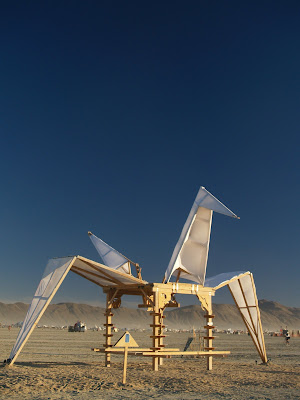
I spent this last week in August living in the dry, arid, lifeless desert at the Burning Man festival, and it was amazing. I had the great fortune of being allowed to arrive early to help build our camp, and as a result I got to see the community grow from the ground up. To watch a city of 50,000 people rise up out of the dust and fill in the dotted outline stitched into the waiting desert was fascinating. To feel simultaneously out of place and at peace with the people and the world around you was exhausting. To live in a place with such an excited, pulsing heartbeat of music and movement, knowing all the time that in seven days it will all disperse and trickle back into the veins of real life is exhilarating. It was an experience I will never forget, but also one that I could never -- not in a million years -- capture with my words.

I will try, of course. I will write about going on a hunt through the midday sun for a slice of apple pie and instead finding a large tent with the words, "Hard Cider: Quench Your Dust" written on its side. An oasis, it would seem, greeting us with rare luck and fortune. We wandered around the side and in moments found ourselves chatting amicably with Tommy, an Irishman from Galway who now owns a pub in Santa Barbara. This was his ninth trip to Burning Man, and each time he brings more kegs of cider to welcome lost souls out of the day's heat. I found myself back in that tent quite a few times throughout the week, both for another pint (or three) of cider to wash down the playa dust, as well as for the company of the people I met there.

I will write about Roo's and my self-imposed quest to seek out and play on every trampoline on the playa. On the first day of wandering, after a snack of bacon and waffles which were well worth the wait, we passed a trampoline that looked far too inviting to pass up. After bouncing and flipping for about half an hour -- an already exhausting activity made even more tiring by the dry, pounding heat; it's a good thing I was wearing my kilt for ventilation -- we decreed that we would have to find and bounce on them all. Six days and seven trampolines later, and after seriously pulling a muscle along the left side of my back, I don't think we were anywhere close to our goal, but it was a valiant effort to be sure. They did make for some epic photos against the deep blue desert sky.

I will write about watching the spinners on the Shiva Vista stage and being blown away by both the performers and the stage itself. The large, square playing space sat out in the open playa, a good hike from center camp, but it was always plainly visible. The stage was flanked at each corner by a massive column of black steel, a fire cannon capable of blasting a pillar of flame twenty feet into the sky. Around the audience space stood a ring of ten or so additional fire rigs which threw flame both straight up, as well as inwards towards the stage. As I watched the burners dance, the cannons pumped their excited tongues of fire into the night, popping and swirling and tossing irregular shadows across the hard desert floor. At full blast, I could feel the orange flames wash over me, a bubble of heat in the cool yet boiling night.

And I will write about these things and more, and I will continue to write for days to come, and it will never come close to capturing the experience as a whole. How can I describe the intense dryness, the dust seeping into my skin and mingling with my sweat, staining every hair on my body a chalky gray? I can't, not in that way that will make you touch your fingertips together to take comfort in the oils on your skin.

I will write about these things, and I will feel like I did out there in the desert: for every thing that I see -- for every sculpture that I touch; for every person that I encounter; for every song that I hear; for every star that I see blinking at me from the night sky -- there will exist a hundred other things that I will never see, will never find, will never even hear about second- or third-hand from others. And that will be okay. Because that is part of the experience, too.

4.10.2008

I Done Did It Good

Today I did a little freelance electrician work for a small theater in the next town over. Woke up at 6.30am, (holy crap was I not ready for that), so I could be on the train by 7.30 and at the theater by 8. My mom greeted me at the bottom of the stairs with, "Oh, wow, I forgot you were getting up this early. I'm impressed you're awake! Too bad I'm going to school, I could have given you a ride." (Thanks, mom).

I got to the theater a bit early, and sat in the amazing morning air until Lauren, the production manager, unlocked the doors and let me in. At first I was annoyed that the first brilliant spring day of the year would be spent in a dark, dusty theater, but then I realized that on any other day I wouldn't even be awake until 11, and I should be grateful to see this so-called "morning" at all.

It was the kind of invigorating theater work I haven't done in so long: I deciphered an incoherent plot; I climbed ladders while carrying too much heavy equipment; I hung, struck and rehung lights; I ran circuits; I ate a donut; I joked about how annoying actors can be. We ended up finishing everything in only 4 hours. When I left, I had cuts and scrapes, not to mention a layer of generic filth, all over my hands and arms. Man, did it feel good.

It seems stupid, however, to have to fill out a bunch of tax forms so they can pay me $52... Minus taxes.

Damn you, IRS. Damn you.

3.02.2008

My Internal Clock Is Analog. And Needs Winding.

I'm nocturnal. I can't deny it. I've always known it. I love all-night parties. I love astronomy. At school I always did my best paper-writing while the sun was dampened and dark. Most of all, I love sleeping, which generally means that my waking hours begin in what most people would call the "Afternoon." And because of these factors, I recently found myself stuck in the most terrible sleep pattern that I can imagine.

  • The average American wakes up between 7.30-9am.
  • I, on the other hand, did not rise until between 1-2pm. Late; I concede.
  • The average American goes to sleep between 9-11.30pm.
  • I, on average, did not hit my pillow until between 4-5am.

I would normally chalk this inconsistency up to what I'll dub the "Employment Factor," (or "EF"): that other people have jobs to go to, while I am, at present, a useless carbon-based humanoid. However, I know other people that are also unemployed, or who work only in the evenings, and their bodies are programmed to somehow bounce awake in accordance with the AAS, ("Average American Schedule"). So it must be more something more.

Recently I have been trying to reprogram myself, to wind and reset my internal clock if you will, and have discovered a most peculiar phenomenon. Setting my alarm for 10.30am, and then my phone alarm for 11am, (well of course I'll ignore the first one), I have experience two different results:

  1. I will turn off the phone alarm, ignore the radio alarm for it's full two hour run, and wake up at 1pm feeling groggy and confused;
  2. I will heed the phone alarm, get up by 11.30am, be proud that I've taken control of my life, and then feel horribly tired and unfocused all day.


Whichever the result, they both end up leading to the same place. By the 6-7pm stretch, I'm feeling tired and in dire need of a nap. I ignore these urges, spend the evening yawning, and push through until whatever seems like a reasonable bedtime.

Inevitably, at this precise moment, something will occur: I will stop feeling tired. I feel energized, creative, social, etc. If I attempt to ignore this newfound energy and go to bed anyway, I will lie awake for up to 2 hours with no result. If I just go with it, (as, you will note by this post's time stamp, I have done tonight), I can work until 4am without even noticing the time. This then makes it even harder to heed my alarms the following morning, and the reprogramming fails again.

What the hell? What is going on here?

2.14.2008

Life Update: 2/14/08

I have come to realize that this blog doesn't have really anything about my actual life on it. Cartoons, yes. Real life, no. So I'mma start trying to post little journal entries when I don't have anything else to post. (That is, when something interesting has happened. Most of the time, I'm a lethargic slug--not particularly news-worthy).

Off we go: Last night I had my first of what I hope will be many single-serve theater jobs in Philly. I found a post on the Theater Alliance of Philadelphia webserv for some guy named Todd looking for a light/sound board op for a two-night performance at the Shubin Theater on Bainbridge St. It was a series of one-act staged readings, and so promised to be simple. I called him up, he told me to show up early to go over the scripts, and that was that.

Well, nearly. Tuesday it snowed and sleeted and was generally gross, and after driving downtown -- which took almost 3 times longer than normal because of weather and traffic -- I got a call from Todd saying he was stillstuck in NJ, and was canceling the show that night. So I spent another 1 1/2 hours driving home. Tons of fun.

Fortunately the next night was clearer, and all went smoothly. The job proved easy enough, (mostly a "lights up, lights down" sort of thing), and Todd ended up paying me for both nights, which was very nice of him. I hung out afterwards with Todd and a few of the younger actor-types, (some students, some no-longer-students-because-we're-full-time-actors-now), and he gave me the leftover wine as a sort of tip. Which worked out fine for me.

So I earned some money last night, plus made a great contact, (Todd often does little shows in that space, and also is planning a Fringe Festival show, and he said I was good people and that he'd call me for the next show). Plus, I'm looking forward to a little PEX Heart/Burn action this weekend, so I'm feeling pretty good at the moment.

I'm sure next week I'll feel like a useless slug again. But for now, I'm good.

And hungry. Time to go raid the fridge. Tally-ho!

2.11.2008

Smiles Filled with Laughter

I've always been intrigued by the etymologies of interesting words. I'm no Latin scholar -- the closest I've gotten is figuring out the basic "amo, amas, amat..." for the purposes of crossword puzzles -- but I do sometimes enjoy dissecting words to find out how they were formed. As a quick example, take the word "awful". In daily speech, this word implies that something is bad or distasteful. But if you look at it literally, the word breaks down into two halves: "awe" + "ful". Nothing in the word itself connotes badness; instead, it should produce awe. Things that are "awful" should fill you with amazement and wonder, not disdain.

En Español, the word for smile is sonrisa. A mi me gusta cuando estás sonriendo -- "I love it when you are smiling." This is, of course, a misnomer -- most English-speaking people would see the word "sunrise" practically leaping out at them. That is, however, a beautiful thought: that one might confuse a smile with a sunrise, or vice versa.

What make this even more interesting to me is, again, the two halves of the word. If you break this noun in half you have "son" + "risa". Son, when taken as a noun, means "sound". Risa, interestingly, means "laughter". Laughter sound. But isn't laughter already a sound? It seems backwards to me. Shouldn't the word for "laughter" be smile sound? Wouldn't that make more logical sense? I also thought that, perhaps, son was originally sin, meaning "without". But that makes it "without laughter," which may technically be true of a smile, though it implies to me that you're probably not full of glee, which would minimize the appearance of said smile, as well.

Anyway, I'm happily perplexed. What do you think? I'd love to hear responses of any kind: Your thoughts on the sonrisa puzzle; other misnomers or poetically constructed words in English or any other language; or any other words with etymologies que causa una sonrisa.

2.06.2008

Brain Power

A thought:

The body is a machine. Complicated, organic and fragile, yes; but a machine.

Every bone is a piece of a frame which gives the body shape. Every muscle is a plaster which defines that shape. Every inch of skin provides protection, like the wax on an expensive car.

The body has mechanical systems, tendons pulling at muscles pulling at fingers, providing motion in every limb and digit. The body has chemical systems, veins and arteries pulling oxygen from the lungs, the heart pumping it around to each cell. The body has plumbing systems, separating waste from fuel and disposing of it efficiently.

And the body has electrical systems, each nerve sending and receiving pulses of energy to and from the brain. Every spec of light we see, every grain of sand we touch, each sound and taste and smell are translations of electrical impulses provided by our bodies' sensory equipment.

And the brain, like the motherboard of a supercomputer, analyzes these impulses, computes an appropriate response, and gives the order. We flinch away when we feel the heat of the stove top on our hands; we salivate when we smell the brownies baking within. We react because we are programmed to react. Those with bad programming do not survive.

What, then, is music? Why do we feel overwhelming calm when we hear DeBussy's "Claire de Lune", feel sadness at a Chopin nocturne, or feel alive with Carl Orff's "O Fortuna"? Normally, the sound of cannon fire would make one alert or fearful; why, then, do we feel powerful during the "1812 Overture"?

But more importantly: from where, then, does music come? Where, among each electrical impulse telling him that the light was dim, the room cold, or the wine deep and rich, did Beethoven find his "Moonlight Sonata"? From where did Liszt or Bach create their many works? From what experience did the child Mozart, age 8, find the inspiration for his first symphony?

Where, for that matter, do we find poetry? Where do we find cartoons, or flower arrangements, or knock-knock jokes, or philosophy, or fine Italian cuisine? These are not reactions, but creations, works of conscious thought generated spontaneously by a piece of electronic hardware.

In all the complex precision of our brains, in all the meticulous engineering that controls each system with perfection, where do we find the mind? Where does it come from? Why is it so unique to every individual?

And why can't it be controlled?

1.29.2008

A Story

Do you ever get the feeling that you are being stalked? I don't mean in that creepy Facebook sort of way, but rather like your being hunted. Like feeling a continuous tingling along your spine, and you know that somewhere, somehow, a pair of eyes is watching you, waiting; the finger just itching to pull the trigger, to let the arrow fly... He had had that feeling all day today.

He was in a mall. He hates malls. He was in the King of Prussia mall to be precise, which is the biggest, most horrible experience of "mall" that I have ever encountered. It's so big that it is actually two malls, which are connected by a land bridge so that foot traffic can avoid the real traffic on the street below. I'm sure it's lovely for most people, but for people who don't like malls it is a frightening mass of brick and mortar and cement and polished tiles. Especially when you have the constant feeling of being watched.

All he needed to do was go to Brookstone, get a barbecue light so his mom would have something to give to his dad for his birthday, and get out. Though he would never have dreamed of spending $50 for what boiled down to a clip-on light bulb, it seemed like a relatively simple mission. Fifteen minutes of consumerism, and he'd be free. (Well, free to drive south for 45 minutes on the turnpike, but there were no perfume counters or mall directories in the car, so it was a step in the right direction). Okay, really more like 25 minutes of consumerism, when you factor in the sheer size of this damned place. But simple. Straightforward.

He parked the car on the ground level of the garage and stepped out onto the concrete. The sound of the locks clicking echoed across the low ceilings. Somehow, despite the bright daylight not 15 feet away, this place was full of shadows. A shiver ran up his spine, and he glanced over his shoulders in response. No movement anywhere. No signs of life. He composed himself and trudged across the roadway, (Speed Limit: 5 MPH), to the sidewalk.

He took a deep breath, held it tight, and pushed through the glass doors.

Bloomingdale's greeted him with its cheery atmosphere and giant posters of attractive yet forgettable men and women. The pale pink flourescent lights made everything glow with false warmth. As predicted, he had entered directly into the department store's perfume section -- why does that always happen? It's a conspiracy of some kind, I swear -- and despite having held his breath he could still taste it floating in the air, each scented particle waiting patiently by his nostrils until he was forced to inhale. He covered his mouth and nose with his sleeve and took a sharp breath. Nope, no good. He could still taste it.

He pushed on, winding around the center display, through a row of women's handbags and large-brimmed hats, until finally he saw the blueish light spilling in from the mall proper. He stepped through the large entranceway and breathed again.

Directly in front of him stood a tall, triangular billboard. It screamed "Mall Directory," although he was currently staring at the silhouette of a man against a washed-out brick wall advertising some sort of cologne. Only the name of the product -- Mistique -- was printed. The mystique for which the advertisers clearly were striving here failed to find its mark; his eyes glazed over, and he looked instead at the only other person in view. A woman was sitting on a bench against a large tiled planter, a small, leafy tree looming over her. Only in a place like this would one require a tree to provide them with shade while they were indoors. The woman was reading a magazine, her purse plopped unceremoniously down next to her, a cane leaning on the armrest. She must be waiting for someone to finish their shopping, he thought. He also imagined she might the sort of person who came to the mall to sit in the indoor shade and read because she found it pleasant. He hoped not.

He turned his attention back to the advertisement. There must be a map of this hellish place on that thing somewhere, he thought, so he went around it to the right. Another advertisement greeted him, this time in the form of a "Hannah Montana In Concert!" poster. He sighed, and completed his lap around the triangular billboard only find yet another advertisement. He glared at the happy-looking woman with the pouty red lips displaying the finest that Maybelline had to offer. He had been fooled, duped, led astray. There was no directory here.

It was then he felt it again: a tingle along his spine. It was so subtle, like a ghost running its finger down the back of his neck and between his shoulder blades, as if the only reason he could detect it was the slight shift in air pressure causing his hairs to sway ever so slightly. It was more of an awareness than a physical feeling, an awareness of being watched.

He peered over his shoulders down the length of the hall. An older couple was walking away from him, the wife on her cell phone, the husband rifling through a white shopping bag. To his left, a planter with shrubbery. To his right, the entranceway to Bloomingdales. No one in sight. This was, perhaps, even stranger than the alternative. Where was everyone? He shifted slightly and looked past the billboard; the woman still sat on the bench, reading her magazine. She had not felt it, clearly. He looked up towards the balconies, where a group of teenagers were being obnoxious in Hot Topic. Fitting, he thought.

...TBC

1.28.2008

Fragment Explosion

In my high school English classes, we would occasionally do exercises called "explosions," where we would take a written work -- usually poetry, though performing this operation on works of prose could be interesting, as well -- and pry at it with our own mind, using a piece of the work as our inspiration. Usually we took a line from within the meat of the poem and used it as the first line of a poem of our own creation. It was especially interesting when, later, our teacher would read through the poem, and wherever we had "exploded" one of its phrases into our own short idea, we would cut the reading off and insert what we had written ourselves. As a result, the original work not only became much longer, it became interesting in a new way. We saw certain words and phrases in a new way based on how our peers had reacted to them. In short, we took the work and made it our own.

I mention this only because it is how and why I approached the following bit of prose. If you read a few posts below, you may notice one labeled "(Fragment)", and that what follows is an expanded version of it. I suppose in the real world one might refer to this as "expanding on a previous idea," or even just "the process of writing." Which is true. But in the same way that the first (Fragment) was written in a spurt of inspiration as the sentences formed in my subconscious of their own volition, this is merely an explosion of that original idea. Perhaps it will grow little by little until I get a publishing contract for the 300-page novel it will become. But for now, baby steps.

* * * * * * * * * * * * *

And beyond hope, beyond his kindest dreams, a surprise greeted him when he awoke. Dew clung to the grass, each blade glistening like a crystal, a precious keepsake polished with care. It clung to the tips of his hair, and as he shook it loose it rained down as a fine mist, each tiny prism flashing, breaking the light into a thousand colors that mixed with the air around him and saturated every detail of the morning.


The light.


The sun did more than rise in that moment; it smiled. And he shined, golden, into the new day.

1.22.2008

(fragment)

And beyond hope, beyond his wildest dreams, a surprise greeted him when he awoke. The sun did more than rise that morning; it smiled.

And he shined, golden, into the new day.